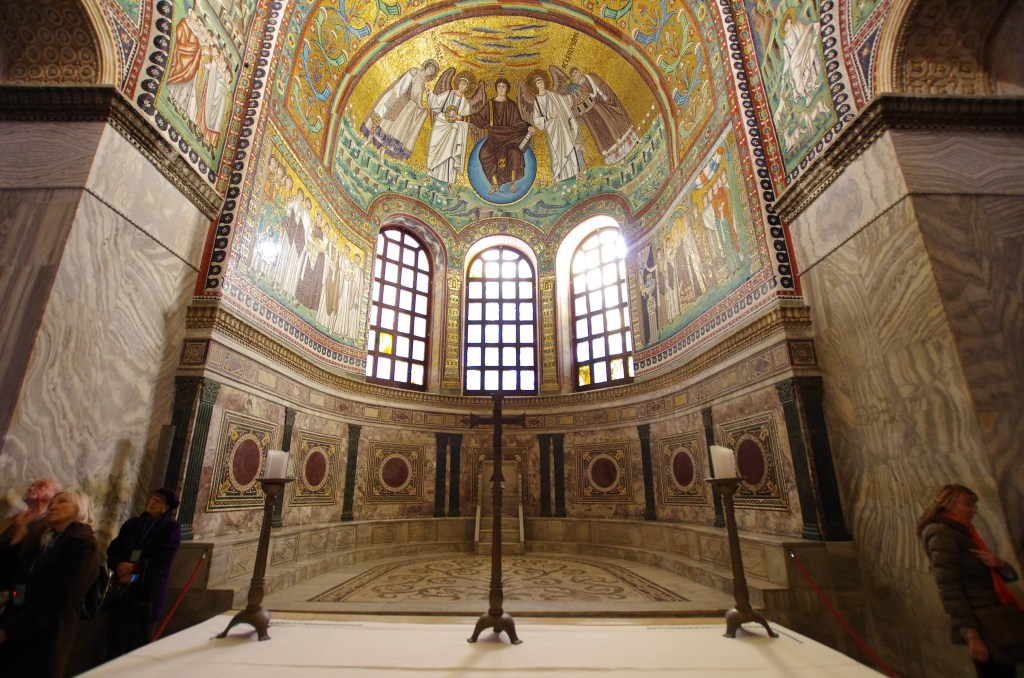
In Ravenna, mosaics are everywhere. Tiny pieces of glass and stone have been catching the light here for more than fifteen centuries, long before the word “pixel” existed. Yet the most compelling thing about the city is not that it protects its past. It is that artists keep discovering new ways to assemble it.
The city’s ninth Biennial of Contemporary Mosaic, which ran from October 2025 into January 2026, brought a new generation of work into dialogue with Ravenna’s remarkable historic monuments. Across museums and public spaces, artists treated the mosaic not as a fixed decorative technique but as a flexible visual language.
Beyond the church wall
A mosaic begins with small units called tesserae, which may be made from glass, stone, ceramic or other materials. Placed together, they can create shimmering surfaces and intricate figures. In the hands of contemporary artists, the same basic principle becomes a way to explore fragmentation, identity and the relationship between image and matter.
The Biennale’s programme showed how varied that approach can be. Artist Omar Mismar presented mosaic-related work addressing contemporary experience. The GAeM International Award for Young Artists and Mosaic brought together practitioners under 35, offering a platform for new experiments with a technique often associated with much older buildings.
Making an image, piece by piece
The physical act of making a mosaic is slow, demanding and surprisingly unforgiving. Every fragment has its own thickness, orientation and reflective quality. A maker chooses not only colour but how light will move across a surface. The gaps between pieces matter as much as the pieces themselves.
This is where contemporary mosaic becomes especially interesting in a digital world. On a screen, an image is assembled from pixels that change instantly. In a mosaic, the units have weight and permanence. The artist can work with the logic of an image while insisting on the stubborn reality of its materials.
A city that keeps teaching
Ravenna’s identity as a mosaic centre is reinforced by its academies, workshops and practising artists. The ancient monuments are extraordinary, but they are also points of departure. New makers are not required to imitate Byzantine saints or imperial portraits. They can question the medium, enlarge it, break it apart and move it into the street.
The result feels less like revival for revival’s sake and more like a continuation. Ravenna’s mosaics are not simply being maintained. They are being argued with, reimagined and made again.
Image: historic mosaics inside the Basilica of San Vitale, Ravenna. This photograph illustrates the city’s mosaic tradition, not a work from the 2025–26 contemporary biennial. San2Kan / Wikimedia Commons, CC BY-SA 4.0.
Sources: Ravenna Turismo — 9th Biennial of Contemporary Mosaic; Ravenna Turismo — Omar Mismar; MAR Ravenna — GAeM Young Artists & Mosaic.