A creature with the body of a jaguar, the wings of a bird and a thousand tiny painted marks across its skin has no reason to exist — except that somebody imagined it, carved it and decided exactly where every colour should go. In Oaxaca, such creatures are the product of a distinctive meeting between folklore, sculpture and exceptional skill.
Known widely as alebrijes, these fantastical figures have become internationally recognisable symbols of Mexican creativity. The name has roots in the papier-mâché creatures made famous by Mexico City artist Pedro Linares, while Oaxaca developed its own celebrated tradition of carved and painted wooden animals, especially in villages such as San Martín Tilcajete.
From a block of wood to a new creature
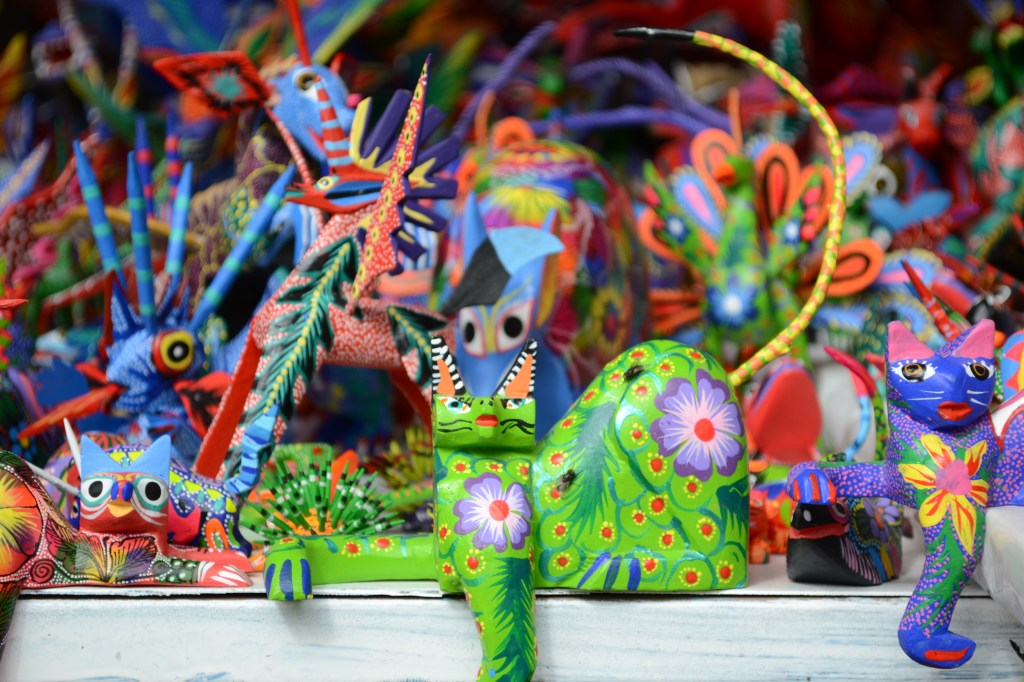
Oaxacan artists often begin with copal wood, carving a form that may mix real and imagined animals. What follows is a meticulous process of painting, sometimes with dots, lines and repeated patterns so intricate they seem impossible at first sight. The work moves from sculpture to surface design without ever becoming merely ornamental.
Among the best-known practitioners are Jacobo and María Ángeles, who established their workshop in 1993. Drawing on Zapotec imagery and local knowledge, their practice has helped bring Oaxacan woodcarving to international audiences. Natural pigments and references to Indigenous symbolism distinguish their work from generic souvenir production.
Why authorship matters
Popularity comes with a complication. Alebrijes have been copied, simplified and mass-produced. A figure that looks colourful in a market might tell little about the craftsperson behind it. For the artists who cut and paint the originals, individual technique, training and cultural context are part of the work’s value.
That difference is especially relevant in a world of endlessly reproducible images. An AI-generated pattern may be visually elaborate, but a hand-carved object has an internal logic of material, balance and years of practice. Its complexity is not only decorative. It is a record of choices.
Tradition as invention
The future of the form does not depend on repeating the same creatures. Contemporary artists can invent new silhouettes and combinations, while passing skills to younger makers through studios and workshops. Every new object becomes both an act of imagination and a continuation of the community’s knowledge.
Oaxaca’s wooden creatures are extraordinary precisely because they do not choose between heritage and fantasy. They can be deeply rooted and completely unexpected at the same time. That is what makes them feel alive.
Image: colourful alebrijes photographed in an Oaxaca craft market; illustrative, not necessarily the work of Jacobo and María Ángeles. Inakiherrasti / Wikimedia Commons, CC BY-SA 3.0.
Sources: Weisman Art Museum — Jacobo & María Ángeles; The Metropolitan Museum of Art — Mexican art collections.