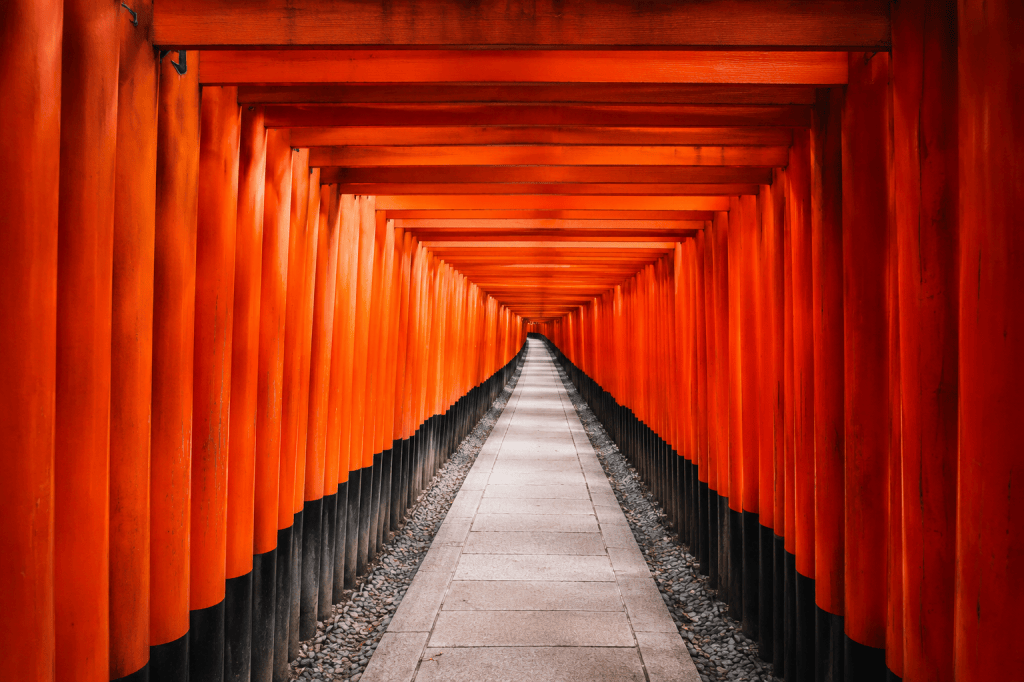
Walk beneath a thousand shades of vermilion and the city seems to disappear. At Fushimi Inari Taisha, one of Kyoto’s most recognisable Shinto shrines, rows of brilliant red torii gates turn a mountainside path into something almost cinematic. It is the kind of place that stays in your mind long after the journey ends.
Founded in 711, the shrine is dedicated to Inari Okami, a deity associated with rice, harvests and prosperity. Over centuries, visitors, families and businesses have donated gates as expressions of gratitude or wishes for good fortune. Today, roughly 10,000 torii of different sizes line the trails of sacred Mount Inari.
The most photographed stretch is Senbon Torii, where closely spaced wooden gates create an extraordinary corridor of colour and perspective. From inside, the repeated frames seem to stretch endlessly ahead; from behind, the inscriptions reveal the names of those who offered them.
Yet the shrine is more than a perfect photograph. Venture beyond the busiest lower paths and you will find smaller shrines, stone steps, lanterns and fox statues tucked into the hillside. Foxes, known as kitsune, are regarded as messengers of Inari rather than the deity itself — a detail that adds another layer to the site’s symbolism.
Getting here is easy. Take the JR Nara Line from Kyoto Station to Inari Station, directly opposite the shrine entrance. Allow time to wander beyond the first tunnel: the mountain paths reward unhurried exploration, and the complete circuit can take a few hours.
Part sacred place, part architectural spectacle, Fushimi Inari is Kyoto at its most compelling — where centuries of belief, countless individual stories and an unforgettable visual rhythm meet in a single walk.
More in Japan: Continue with our Tokyo story.